No sales manager? No problem. Turn your team into a selling MACHINE

Let's start with a bet.
I bet you're one of three people:
The owner-operator. You're running around like a chicken with its head cut off, plugging holes and keeping the sales engine alive at the same time.
The one with a manager. But your manager can't live in the studio 24/7 to catch every trial conversation. (Wouldn't that be nice. Also, illegal.)
The one with a decent team. They can sell on the floor... when the stars align. It's scattered, it's hard to coordinate, and it eats way too much time.
Doesn't matter which one you are. You all want the same thing:
More sales.
So let's get you more sales.
The whole game comes down to two things
I built this system into my own studio. It worked. Not "kinda worked" — it took us from 2 floor memberships a month to 14.
More on that later. First, the philosophy, because if you don't get this part, the tactics won't stick.
After all the trial and error, I'm convinced a team's ability to sell comes down to solving exactly two problems:
Right info → right person → right time.
Team-wide accountability.
That's it. Solve those two and the sales show up. Miss either one and you're back to texting your coaches before class and praying they remember.
The best part? When your superstar closer quits for a better gig, the machine keeps running. You lose a person, not the system.
First, kill the word "sales"
Before we touch a single tool, we're changing the language.
Your coaches don't sell. They consult and prescribe.
You're not a gym peddling memberships. You're health professionals, and your clients are patients who want a change they can't figure out on their own. (Or don't want to. Either way — that's why they're here.)
Put it in the job description. Say it in every meeting. The words shape the behavior.
Selling feels gross. Prescribing feels like the job. Coaches will lean into the second one all day.
Then, pay people to care
Language changes the mindset. Money changes the effort.
Here's the incentive structure I run:
15% of any initial sale. Sell a $199 month-to-month? That's $30 in the coach's pocket.
Double commission if the whole team hits quota.
The first one rewards the individual. The second one makes the team drag each other across the line. Now your coaches are texting each other about who's closing — not you nagging them.
Make the team goal attainable but challenging. Start a sales group chat. Post wins. Make it a little bit of a game.
People will surprise you when there's a scoreboard.
The Framework: attach the sale to the client, not the calendar
Here's the core idea, and it's stupidly simple:
Take detailed, concise sales info. Attach it to the client. Serve it to the coach at the exact moment they need it.
No daily reports. No pre-class texts. No "hey did you talk to Sarah?" follow-ups. The info lives on the client and surfaces when the coach walks the floor.
If your CRM has client alerts, you can start today. I'll show you how in MindBody, because that's what most of us run. Three tools:
1. Coach Action Item (MindBody Red Alert)
A single, clearly defined thing a coach can do in class. Then mark done or not done.
The rules matter here, or nobody uses it:
One clear action. Something a coach can realistically do and mark complete or incomplete. Not a paragraph of vibes.
Completed = deleted. The second it's done, it's gone. Stale alerts kill the whole system. Follow-up needed? Drop a new action item in its place.
Incomplete = enhanced. Left the item undone? Add a note so the next coach can finish the job.
Coaches only. If something important came out of it that the sales team needs, bump it up to the client Notes.
Tag it. Name + date, every time, so anyone can tell if it's still good.

2. Injuries / Health Info (MindBody Yellow Alert)
Long-living info about injuries or health stuff a coach needs to know. Purely informational — it keeps coaches from putting a bad knee through a jump-squat circuit.
Tag it with a name and date so you know if it's stale. If the ailment clears up, kill the alert.
3. Conversation Notes (MindBody client Notes)
Your rapport scratchpad. The living journal. Goals, schedule, work-life, habits, past conversations, completed action items — anything that tells the team where this human is on their journey.
Tag it — name and date.
Heads up: clients can sometimes see these notes. Use that. Nothing builds trust like a client realizing how much you actually remember about them.
That's the whole framework. Everything lives with the client. Your sales team's only job is to watch and set alerts.
Executing: The Alley-Oop 🏀
Setup takes about a month for the team to get comfortable. Then the sales start rolling in. Be patient through the awkward phase.
Here's the play I run. I call it the Alley-Oop.
You set up the sale. You hand the coach the ball. They score.
The better your pass, the easier the dunk.
Step 1 — Get them to the Hot Class.
The "hot" class is the class where the sale happens. A trialer is hot when they're ready to buy. For my studio that's the 3rd class — it fits our coaches' confidence and our trial offer. Yours might be the 1st. Pick what works.
Your first job with any new trialer: book them into their hot class and make sure they show up.
Step 2 — Set the perfect Action Item.
As much detail as needed, without drowning the coach. Include their goals, the membership to offer, and a fallback if the first doesn't land.
Like this:
"Sarah is a nurse with a rough schedule. She can make it 3x/week — MWF at noon — but needs accountability. We talked unlimited to fit that schedule and push her to actually use the days. Offer the M2M Unlimited at $199. Drop the first month to $99 to lower the barrier. If she balks, offer the 8x monthly at $139 flat. — Evan V, 6/7/26"
Look at that dunk.
As the coach, I walk in knowing exactly what was discussed, exactly what to offer, and exactly what to do if she hesitates. I'm not fumbling through MindBody trying to find the right membership mid-conversation. I just... score.

Making it dead-simple: the RepFlow app (it's free)
Now you're thinking: "This is great, but it's a lot of clicking around MindBody."
Yeah. It is. So we fixed it.
We built a free iOS app that runs this entire framework for you.
Here's what it actually does:
It hooks straight into MindBody's alert system — the one you're already using. No migration. No new database. Your Red Alerts, Yellow Alerts, and Notes just show up.
It replaces the MindBody check-in screen. Your coaches already tap clients in as they walk through the door. Now they do it in RepFlow instead. Same job, zero app-switching. Fully compatible with everything MindBody does.
The upgrade: the pre-game report. As clients check in, the coach sees a clean pre-game summary — every action item, every note, every heads-up — right there. The right info, at the right time, without digging.


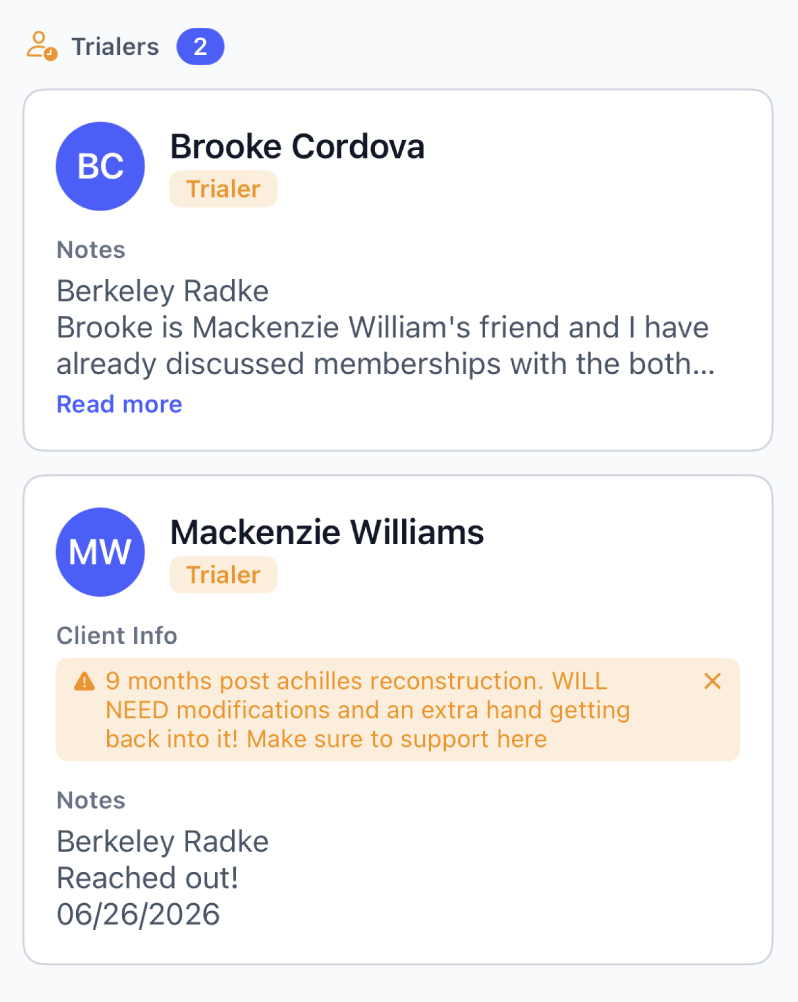
That's the whole pitch. It's the check-in tool your coaches already need, plus it quietly hands them the sale on the way in.
And yes — it does the AI stuff too.
If you want it, the app also runs a post-game report that automates all those alert rules for you (completed items removed, incomplete ones flagged, notes bubbled up). It can pull attendance, find every trialer sitting in a hot class, and build the Alley-Oop for you. All you do is keep your studio offers updated.
But you don't need any of that to get value. The AI is the cherry. The check-in-plus-pre-game is the sundae.

If that sounds like something you'd want in your studio, you can put your name down here. No pressure — I'd rather you read the rest first.
The stats (the part you actually care about)
We used to close over the phone. Which is a fancy way of saying we tried to close over the phone and mostly got voicemails.
The month we turned this system on:
We went from 2 floor memberships/month → 14.
The next month was more modest at 10.
We've settled at roughly 5x our original output.
That's about $1,352 in extra revenue. Every month.
And here's the honest part: not every coach will embrace it. A few will run with it and become monsters. Others will drag their feet.
That's fine. The team goal pulls the stragglers along. Watch who catches on — and feed those coaches more Alley-Oops. Reward the doers with more chances to score.
Your move
You don't need a superstar sales manager. You need a repeatable, learnable system that lives on the client and surfaces at the right moment.
That's the whole thing:
Reframe selling as prescribing.
Pay people to care.
Attach the sale to the client with three simple alerts.
Run the Alley-Oop into the hot class.
(Optional but easy) Let the app do the busywork.
Build it, give it a month, and watch the floor start closing.
When you're ready to make it stupid-easy, RepFlow is free and it's right here.
Go get your dunks. 🏀